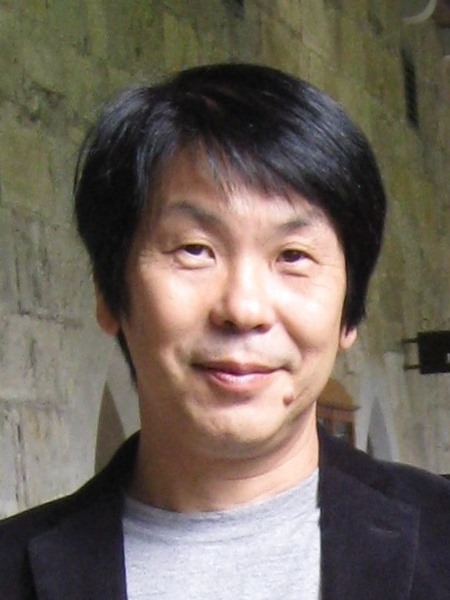
Katsumi Inoue's Home Page (in English / in Japanese)

Last updated:  2013.05.15    

Name:  INOUE, Katsumi
Degree:  Dr. Eng., Kyoto University
Position/Affiliation:  Professor, Principles of Informatics Research Division,
National Institute of Informatics, Japan
E-mail:  inoue (at) nii (dot) ac (dot) jp
Laboratory:  Inference and Learning Group (Inoue Laboratory)
Home Pages: 
  • http://research.nii.ac.jp/~inoue
  • http://www.nii.ac.jp/en/faculty/informatics/inoue_katsumi/
  • http://researchmap.jp/vivre/english/
  • Research Fields: 
     
    • Intelligent Informatics
    • Logic Programming
    • Systems Biology
    Research Topics: 
     
    • Logical Foundations for Artificial Intelligence
    • Automated Reasoning and Knowledge Representation
    • Hypothesis-Finding Based on Induction and Abduction
    • Multi-Agent Systems and Distributed Reasoning
    • Logic/Constraint/Answer-Set Programming
    • Knowledge Discovery in Systems Biology
    • Network Inference and Dynamics
    • Systems Resilience
    Education: 
     
    • 1993 Jan. PhD Degree (Engineering), Dept. of Applied Mathematics and Physics, Kyoto University
    • 1984 Mar. Master's Degree, Dept. of Applied Mathematics and Physics, Kyoto University
    • 1982 Mar. Bachelor's Degree, Dept. of Applied Mathematics and Physics, Kyoto University
    Career (since 2004): 
     
    Current Courses: 
     
    • Foundations of Artificial Intelligence
    • Introduction to Intelligent Systems Science, I
    Students (since 2004): 
     
    • Tony Ribeiro (Department of Informatics, The Graduate University for Advanced Studies, 2012.10-)
    • Takehide Soh (Department of Informatics, The Graduate University for Advanced Studies, 2008.4-2011.09)
    • Yoshitaka Yamamoto (Department of Informatics, The Graduate University for Advanced Studies, 2006.10-2010.09)
    • Tony Ribeiro (Master of Computer Science, Departement Informatiqué, Université d'Angers, France, 2012.02-2012.08)
    • Gabriel Synnaeve (Master of Informatics, ENSIMAG, Université Joseph Fourier, Grenoble, France, 2009.02-2009.06)
    • Eiji Iwauchi (Graduate School of Science and Technology, Kobe University, 2004.4-2005.3)
    • Takayuki Okamoto (Graduate School of Science and Technology, Kobe University, 2004.4-2005.3)
    • Yoshitaka Yamamoto (Graduate School of Science and Technology, Kobe University, 2004.4-2005.3)
    Awards: 
     
    • The 3rd Prize of Best Challenges and Visions Papers at the 12th International Conference on Autonomous Agents and Multi-Agent Systems (AAMAS 2013)
    • IEEE Computer Society Japan Chapter JAWS Young Researcher Award 2012 (Tenda Okimoto)
    • Takahasi Award at The 28th Conference of Japan Society for Software Science and Technology 2011 (Hidetomo Nabeshima)
    • 1st in UNSAT and 2nd in SAT+UNSAT and UNSAT WC Time at SAT 2011 Competition (SAT Solver glueminisat by Hidetomo Nabeshima)
    • The Best Student Paper Award at The 2011 International Conference on Bioinformatics Models, Methods and Algorithms (BIONINFORMATICS 2011) (Gabriel Synnaeve)
    • The Best Student Paper Award at The 20th International Conference on Inductive Logic Programming (ILP 2010) (Yoshitaka Yamamoto)
    • JSAI Annual Conference Award 2009 (Takehide Soh)
    • Session Best Presentation Award at SCIS & ISIS 2006 (Andrei Doncescu)
    • JSAI SIG Research Award 1999
    • IPSJ Convention Award 1987
    Refereed Publications (Selection) (since 2004): 
     
    1. Katsumi Inoue, Tony Ribeiro, and Chiaki Sakama.  Learning from Interpretation Transition.  Machine Learning, to appear, 2013. doi: 10.1007/s10994-013-5353-8.
    2. Katsumi Inoue, Andrei Doncescu, and Hidetomo Nabeshima.  Completing Causal Networks by Meta-Level AbductionMachine Learning, 91(2):239-277, 2013.
    3. Chiaki Sakama and Katsumi Inoue.  Abduction, Unpredictability and Garden of Eden.  Logic Journal of the IGPL, to appear, 2013. doi: 10.1093/jigpal/jzt015.
    4. Tenda Okimoto, Naoto Ikegai, Tony Ribeiro, Katsumi Inoue, Hitoshi Okada, Hiroshi Maruyama.  Cyber Security Problem Based on Multi-Objective Distributed Constraint Optimization Technique.  Proceedings of the 1st Workshop on Systems Resilience (WSR 2013), in: Proceedings of the 43rd Annual IEEE/IFIP International Conference on Dependable Systems and Networks (DSN 2013), to appear, June 24th, 2013.
    5. Hei Chan and Katsumi Inoue.  Applying Robustness Analysis of Dynamic Models to the Problem of Systems Resilience.  Proceedings of the 5th Symposium on Resilience Engineering, to be presented as a poster, June 2013.
    6. Daniel Sykes, Domenico Corapi, Jeff Magee, Jeff Kramer, Alessandra Russo, and Katsumi Inoue.  Learning Revised Models for Planning in Adaptive Systems. In: Proceedings of the 35th International Conference on Software Engineering (ICSE 2013), to appear, San Francisco, California, USA, May 2013. (Teaser)
    7. Nicolas Schwind, Tenda Okimoto, Katsumi Inoue, Hei Chan, Tony Ribeiro, Kazuhiro Minami, and Hiroshi Maruyama.  Systems Resilience: A Challenge Problem for Dynamic Constraint-Based Agent Systems.  In: Takayuki Ito, Catholijn Jonker, Maria Gini, and Onn Shehory (eds.), Proceedings of the 12th International Conference on Autonomous Agents and Multiagent Systems (AAMAS 2013) (Saint Paul, MN, USA), pages 785-788, May 2013.  Awarded "Best Challenges and Visions Papers Nominee".
    8. Tenda Okimoto, Yuko Sakurai, Makoto Yokoo, and Katsumi Inoue.  Pseudo-Tree Based Hybrid Algorithm for Distributed Constraint Optimization.  Open Peer-Review Workshop on Decentralized Coordination 2013 (WDC 2013), Melbourne, Florida, USA, April 6th, 2013.
    9. Yoshitaka Yamamoto, Katsumi Inoue, and Koji Iwanuma.  Heuristic Inverse Subsumption in Full-Clausal Theories.  In: Fablizio Riguzzi and Filip Zelezny (eds.): Inductive Logic Programming: Revised Selected Papers from the 22nd International Conference (ILP 2012), Lecture Notes in Artificial Intelligence, Vol.7842, pp.241-256, Springer, 2013 (to appear).
    10. Yoshitaka Yamamoto, Koji Iwanuma, and Katsumi Inoue.  Non-Monotone Dualization via Monotone Dualization.  In: Fabrizio Riguzzi and Filip Zelezny (eds.), Late Breaking Papers from the 22nd International Conference on Inductive Logic Programming (ILP 2012), CEUR Workshop Proceedings (CEUR-WS.org), Vol.975, pp.74-79, April 2013.
    11. Andrei Doncescu, Katsumi Inoue, and Anne Pradine.  MicroRNA Analysis by Hypothesis Finding Technique.  In: Fabrizio Riguzzi and Filip Zelezny (eds.), Late Breaking Papers from the 22nd International Conference on Inductive Logic Programming (ILP 2012), CEUR Workshop Proceedings (CEUR-WS.org), Vol.975, pp.26-37, April 2013.
    12. Katsumi Inoue, Chiaki Sakama, and Lena Wiese.  Confidentiality-Preserving Publishing of EDPs for Credulous and Skeptical Users.  In: Post-Conference Proceedings of the 19th International Conference on Applications of Declarative Programming and Knowledge Management (INAP 2011) and the 25th Workshop on Logic Programming (WLP 2011), Lecture Notes in Artificial Intelligence, to appear, Springer, 2013.
    13. Haruki Noritake, Mutsunori Banbara, Takehide Soh, Naoyuki Tamura, and Katsumi Inoue.  Construction of Packing Arrays Using SAT Encoding (in Japanese).  The 15th JSSST Workshop on Programming and Programming Languages (PPL 2013), March 5th, 2013.
    14. Katsumi Inoue, Gauvain Bourgne, and Takayuki Okamoto.  Distributed Consequence Finding: Partition-Based and Cooperative Approaches.  In: Joaquim Filipe and Ana Fred (eds.), Agents and Artificial Intelligence: Revised Selected Papers from the 3rd International Conference (ICAART 2011), Communications in Computer and Information Science, Vol.271, pp.429-444, Springer, 2013.
    15. Gabriel Synnaeve, Katsumi Inoue, Andrei Doncescu, Hidetomo Nabeshima, Yoshitaka Kameya, Masakazu Ishihata, and Taisuke Sato.  Discretized Kinetic Models for Abductive Reasoning in Systems Biology.  In: Ana Fred, Joaquim Filipe and Hugo Gamboa (eds.), Biomedical Engineering Systems and Technologies: Revised Selected Papers from the 4th International Joint Conference (BIOSTEC 2011), Communications in Computer and Information Science, Vol.273, pp.141-154, Springer, 2013.
    16. Martin Brain, Esra Erdem, Katsumi Inoue, Johannes Oetsch, Jörg Pührer, Hans Tompits, and Cemal Yílmaz.  Event-Sequence Testing Using Answer-Set Programming.  International Journal on Advances in Software, 5(3&4):236-250, 2012.
    17. Takehide Soh, Katsumi Inoue, Tomoya Baba, Toyoyuki Takada, and Toshihiko Shiroishi.  Evaluation of the Prediction of Gene Knockout Effects by Minimal Pathway Enumeration.  International Journal on Advances in Life Sciences, 4(3&4):154-165, 2012.
    18. Thu-Le Pham and Katsumi Inoue.  Minimal Generalization for Conjunctive Queries.  In: Multi-Disciplinary Trends in Artificial Intelligence: Proceedings of the 6th International Workshop (MIWAI 2012), Lecture Notes in Artificial Intelligence, Vol.7694, pp.246-257, Springer, 2012.
    19. Tony Ribeiro, Katsumi Inoue, and Gauvain Bourgne.  Modular Reasoning in Multi-Agent Systems Using Meta-Knowledge and Answer Set Programming.  International Joint Agent Workshop and Symposium 2012 (IJAWS 2012), Kakegawa, Japan, October 26th, 2012.
    20. Kazuhiro Minami, Tenda Okimoto, Tomoya Tanjo, Nicolas Schwind, Hei Chan, Katsumi Inoue, and Hiroshi Maruyama.  Formalizing the Resilience of Open Dynamic Systems.  Joint Agent Workshop and Symposium 2012 (JAWS 2012), Kakegawa, Japan, October 26th, 2012.
    21. Tenda Okimoto, Yongjoon Joe, Suguru Ueda, Atsushi Iwasaki, Yuko Sakurai, Makoto Yokoo, and Katsumi Inoue.  Complete/Incomplete Algorithms for Multi-Objective DCOP (in Japanese).  Joint Agent Workshop and Symposium 2012 (JAWS 2012), Kakegawa, Japan, October 26th, 2012, Received "IEEE Computer Society Japan Chapter JAWS Young Researcher Award".
    22. Tenda Okimoto, Masashi Yamamoto, Yuko sakurai, Makoto Yokoo, and Katsumi Inoue.  BnB-ADOPTp: A Hybrid Algorithm for Distributed Constraint Optimization (in Japanese).  Joint Agent Workshop and Symposium 2012 (JAWS 2012), Kakegawa, Japan, October 25th, 2012.
    23. Maxime Folschette, Loïc Paulevé, Katsumi Inoue, Morgan Magnin and Olivier Roux.  Concretizing the Process Hitting into Biological Regulatory Networks.  In: David Gilbert and Monika Heiner (eds.), Proceedings of the 10th International Conference on Computational Methods in Systems Biology (CMSB 2012), Lecture Notes in Bioinformatics, Vol.7605, pp.166-186, Springer, 2012.
    24. Maxime Folschette, Loïc Paulevé, Katsumi Inoue, Morgan Magnin and Olivier Roux.  Abducing Biological Regulatory Networks from Process Hitting models.  In: Pre-Proceedings of ECML-PKDD 2012 Workshop on Learning and Discovery in Symbolic Systems Biology, pp.24-35, 2012.
    25. Mutsunori Banbara, Naoyuki Tamura, and Katsumi Inoue. Generating Event-Sequence Test Cases by Answer Set Programming with the Incidence Matrix. In: Agostino Dovier, Vítor Santos Costa (eds.): Technical Communications of the 28th International Conference on Logic Programming (ICLP 2012), pp.86-97, 2012.
    26. Maheen Bakhtyar, Lena Wiese, Katsumi Inoue, and Nam Dang.  Using Conceptual Inductive Learning for Cooperative Query Answering.  The 36th Annual Conference of the German Classification Society on Data Analysis, Machine Learning and Knowledge Discovery (GfKI 2012), Hildesheim, Germany, August 3rd, 2012.
    27. Katsumi Inoue and Chiaki Sakama.  Oscillating Behavior of Logic Programs.  In: Esra Erdem, Joohyung Lee, Yuliya Lierler, and David Pearce (eds.), Correct Reasoning—Essays on Logic-Based AI in Honour of Vladimir Lifschitz, Lecture Notes in Artificial Intelligence, Vol.7265, pp.345-362, 2012.
    28. Gauvain Bourgne, Katsumi Inoue, and Nicolas Maudet.  Finding New Consequences of an Observation in a Multi-Agent System.  Proceedings of the 11th International Conference on Autonomous Agents and Multiagent Systems (AAMAS 2012), pp.1223-1224, 2012.
    29. Hidetomo Nabeshima, Koji Iwanuma, and Katsumi Inoue.  GlueMiniSat 2.2.5: A Fast SAT Solver with an Aggressive Acquiring Strategy of Glue Clauses (in Japanese)Computer Software, 29(4):146-160, 2012.
    30. Katsumi Inoue.  DNF Hypotheses in Explanatory Induction.  In: Stephen Muggleton, Alireza Tamaddoni-Nezhad, and Francesca A. Lisi (eds.): Inductive Logic Programming: Revised Selected Papers from the 21st International Conference (ILP 2011), Lecture Notes in Artificial Intelligence, Vol.7207, pp.173-188, Springer, 2012.
    31. Yoshitaka Yamamoto, Katsumi Inoue, and Koji Iwanuma.  Comparison of Upward and Downward Generalizations in CF-Induction.  In: Stephen Muggleton, Alireza Tamaddoni-Nezhad, and Francesca A. Lisi (eds.): Inductive Logic Programming: Revised Selected Papers from the 21st International Conference (ILP 2011), Lecture Notes in Artificial Intelligence, Vol.7207, pp.373-388, Springer, 2012.
    32. Stephen Muggleton, Luc De Raedt, David Poole, Ivan Bratko, Peter Flach, Katsumi Inoue, and Ashwin Srinivasan.  ILP Turns 20: Biography and Future ChallengesMachine Learning, 86(1):3-23, 2012.
    33. Yoshitaka Yamamoto, Katsumi Inoue, and Koji Iwanuma.  Inverse Subsumption for Complete Explanatory InductionMachine Learning, 86(1):115-139, 2012.
    34. Barthélémy Dworkin, Andrei Doncescu, Jean-Charles Faye, and Katsumi Inoue.  Model of Double Strand Break of DNA in Logic-Based Hypothesis Finding.  In: Stephen Muggleton, Hiroaki Watanabe, Alireza Tamaddoni-Nezhad, and Jianzhong Chen (eds.), Latest Advances in Inductive Logic Programming: Late-Breaking Proceedings of ILP 2011, Imperial College Press, to appear, 2012.
    35. Andrei Doncescu, Sebastien Regis, Katsumi Inoue, and Nathalie Goma.  Physiological Analysis of Yeast Cell by Intelligent Signal Processing.  In: Ganesh R. Naik (ed.), Applied Biological Engineering - Principles and Practice, Chapter 19, pp.435-460, InTech, 2012.
    36. Takehide Soh, Katsumi Inoue, Tomoya Baba, Toyoyuki Takada, and Toshihiko Shiroishi.  Predicting Gene Knockout Effects by Minimal Pathway Enumeration. In: Petre Dini and Pascal Lorenz (eds.), Proceedings of the 4th International Conference on Bioinformatics, Biocomputational Systems and Biotechnologies (BIOTECHNO 2012), pp.11-19, ThinkMind, 2012.
    37. Takehide Soh and Katsumi Inoue.  Enumerating Minimal Active Metabolic Pathways by Model Generation (in Japanese).  Journal of the Japanese Society for Artificial Intelligence, 27(3):204-212, 2012.
    38. Oliver Ray, Takehide Soh, and Katsumi Inoue.  Analyzing Pathways Using ASP-Based Approaches.  In: Katsuhisa Horimoto, Masahiko Nakatsui, and Nikolaj Popov (eds.), Algebraic and Numeric Biology: Proceedings of the 2010 International Conference (ANB 2010), Lecture Notes in Computer Science, Vol.6479, pp.167-183, Springer, 2012. 
    39. Gauvain Bourgne and Katsumi Inoue.  Partition-Based Consequence FindingProceedings of the 23rd IEEE International Conference on Tools with Artificial Intelligence (ICTAI 2011), pp.641-648, IEEE Computer Society, 2011.
    40. Esra Erdem, Katsumi Inoue, Johannes Oetsch, Jörg Pührer, Hans Tompits, and Cemal Yílmaz.  Answer-Set Programming as a New Approach to Event-Sequence Testing.  In: Teemu Kanstrén (ed.), Proceedings of the 3rd International Conference on Advances in System Testing and Validation Lifecycle (VALID 2011), pp.25-34, Xpert Publishing Services, 2011. 
    41. Katsumi Inoue and Lena Wiese.  Generalizing Conjunctive Queries for Informative Answers.  In: Henning Christiansen, Guy De Tré, Adnan Yazici, and Sławomir Zadrożny (eds.), Flexible Query Answering Systems: Proceedings of the 9th International Conference (FQAS 2011), Lecture Notes in Artificial Intelligence, Vol.7022, pp.1-12, Springer, 2011. 
    42. Katsumi Inoue, Chiaki Sakama, and Lena Wiese.  Confidentiality-Preserving Data Publishing for Credulous Users by Extended Abduction.  The 19th International Conference on Applications of Declarative Programming and Knowledge Management (INAP 2011), appeared in: CoRR arXiv:1108.5825, 2011. 
    43. Katsumi Inoue.  Logic Programming for Boolean NetworksProceedings of the 22nd International Joint Conference on Artificial Intelligence (IJCAI-11), pp.924-930, AAAI Press, 2011.
    44. Koji Iwanuma, Hidetomo Nabeshima, and Katsumi Inoue.  First-Order Equational Reasoning: Theory and Practice (in Japanese).  Computer Software, 28(4):282-305, 2011.
    45. Domenico Corapi, Daniel Sykes, Katsumi Inoue, and Alessandra Russo.  Probabilistic Rule Learning in Nonmonotonic Domains.  In: João Leite, Paolo Torroni, Thomas Ågotnes, Guido Boella and Leon van der Torre (eds.), Computational Logic in Multi-Agent Systems: Proceedings of the 12th International Workshop (CLIMA-XII), Lecture Notes in Artificial Intelligence, Vol.6814, pp.243-258, Springer, 2011. 
    46. Gauvain Bourgne, Katsumi Inoue, and Nicolas Maudet.  Towards Efficient Multi-Agent Abduction Protocols.  In: Mehdi Dastani, Amal El Fallah-Seghrouchni, Jomi Hubner, and João Leite (eds.), Languages, Methodologies, and Development Tools for Multi-Agent Systems, Revised Selected Papers from the 3rd International Workshop (LADS 2010), Lecture Notes in Artificial Intelligence, Vol.6822, pp.19-38, Springer, 2011. 
    47. Gauvain Bourgne and Katsumi Inoue.  Query-driven Coordination of Multiple Answer Sets.  In: Andrea Omicini, Sebastian Sardina, and Wamberto Vasconcelos (eds.), Declarative Agent Languages and Technologies VIII: Revised, Selected, and Invited Papers from the 8th International Workshop (DALT 2010), Lecture Notes in Artificial Intelligence, Vol.6619, pp.40-59, Springer, 2011. 
    48. Katsumi Inoue and Chiaki Sakama.  Exploring Relations between Answer Set Programs.  In: Marcello Balduccini and Tran Cao Son (eds.), Logic Programming, Knowledge Representation, and Nonmonotonic Reasoning: Essays Dedicated to Michael Gelfond on the Occasion of His 65th Birthday, Lecture Notes in Artificial Intelligence, Vol.6565, pp.91-110, Springer, 2011. 
    49. Katsumi Inoue, Andrei Doncescu, and Hidetomo Nabeshima.  Hypothesizing about Causal Networks with Positive and Negative Effects by Meta-Level Abduction.  In: Paolo Frasconi and Francesca A. Lisi (eds.), Inductive Logic Programming: Revised Papers from the 20th International Conference (ILP 2010), Lecture Notes in Artificial Intelligence, Vol.6489, pp.114-129, Springer, 2011. 
    50. Taisuke Sato, Masakazu Ishihata, and Katsumi Inoue.  Constraint-Based Probabilistic Modeling for Statistical AbductionMachine Learning, 83(2):241-264, 2011.
    51. Chiaki Sakama and Katsumi Inoue.  Inductive Equivalence in Clausal Logic and Nonmonotonic Logic ProgrammingMachine Learning, 83(1):1-29, 2011.
    52. Grégoire Lejay, Katsumi Inoue, and Andrei Donscecu.  Application of Meta-Level Abduction for the Treatment of Hypertension Using SOLAR.  Proceedings of the 2011 IEEE International Workshop on Bioinformatics and Life Science Modeling and Computing (BLSMC 2011), in: Proceedings of the 25th International Conference on Advanced Information Networking and Applications (AINA 2011), pp.495-500, IEEE Computer Society, 2011.
    53. Katsumi Inoue, Gauvain Bourgne, and Takayuki Okamoto.  Complete Distributed Consequence Finding with Message Passing.  Proceedings of the 3rd International Conference on Agents and Artificial Intelligence (ICAART 2011), pp.134-143, SciTePress, 2011.
    54. Gabriel Synnaeve, Katsumi Inoue, Andrei Doncescu, Hidetomo Nabeshima, Yoshitaka Kameya, Masakazu Ishihata, and Taisuke Sato.  Kinetic Models and Qualitative Abstraction for Relational Learning in Systems Biology.  Proceedings of the International Conference on Bioinformatics Models, Methods and Algorithms (BIOINFORMATICS 2011), pp.47-54, SciTePress, 2011, Received "The Best Student Paper Award".
    55. Yoshitaka Kameya, Gabriel Synnaeve, Andrei Doncescu, Katsumi Inoue, and Taisuke Sato.  A Bayesian Hybrid Approach to Unsupervised Time Series DiscretizationProceedings of the 15th Conference on Technologies and Applications of Artificial Intelligence (TAAI 2010), pp.342-349, IEEE Computer Society, 2010.
    56. Mutsunori Banbara, Haruki Matsunaka, Naoyuki Tamura, and Katsumi Inoue.  Generating Combinatorial Test Cases by Efficient SAT Encodings Suitable for CDCL SAT Solvers.  In: Christian Fermüller and Andrei Voronkov (eds.), Proceedings of the 17th International Conference on Logic for Programming, Artificial Intelligence and Reasoning (LPAR-17), Lecture Notes in Computer Science, Vol.6397, pp.112-126, Springer, 2010.
    57. Takehide Soh, Katsumi Inoue, Naoyuki Tamura, Mutsunori Banbara, and Hidetomo Nabeshima.  A SAT-Based Method for Solving the Two-dimensional Strip Packing ProblemFundamenta Informaticae, 102(3,4):467-487, 2010.
    58. Gauvain Bourgne, Katsumi Inoue, and Nicolas Maudet.  Towards Efficient Multi-Agent Abduction Protocols.  Proceedings of the 3rd International Workshop on Languages, Methodologies and Development Tools for Multi-Agent Systems (LADS 2010), pp.34-40, in: Olivier Boissier, Amal El Fallah Seghrouchni, Salima Hassas, and Nicolas Maudet (eds.), Proceedings of the Multi-Agent Logics, Languages, and Organisations Federated Workshops (MALLOW 2010), CEUR Workshop Proceedings (CEUR-WS.org), Vol.627, 2010.
    59. Gauvain Bourgne, Katsumi Inoue, and Nicolas Maudet.  Abduction of Distributed Theories through Local InteractionsProceedings of the 19th European Conference on Artificial Intelligence (ECAI 2010), pp.901-906, IOS Press, 2010.
    60. Takehide Soh and Katsumi Inoue.  Identifying Necessary Reactions in Metabolic Pathways by Minimal Model GenerationThe 6th Conference on Prestigious Applications of Artificial Intelligence (PAIS 2010), in: Proceedings of the 19th European Conference on Artificial Intelligence (ECAI 2010), pp.277-282, IOS Press, 2010.
    61. Takehide Soh and Katsumi Inoue.  Finding Minimal Reaction Sets in Large Metabolic Pathways.  Proceedings of the 6th Workshop on Constraint Based Methods for Bioinformatics (WCB 2010), pp.54-68, Edinburgh, 2010.
    62. Katsumi Inoue, Andrei Doncescu, and Hidetomo Nabeshima.  Hypothesizing about Networks by Meta-Level Abduction.  The 20th International Conference on Inductive Logic Programming (ILP 2010), 2010. 
    63. Yoshitaka Yamamoto, Katsumi Inoue, and Koji Iwanuma.  From Inverse Entailment to Inverse Subsumption.  The 20th International Conference on Inductive Logic Programming (ILP 2010), 2010, Received "The Best Student Paper Award" sponsored by Machine Learning Journal.
    64. Katsumi Inoue, Koichi Furukawa, Ikuo Kobayashi, and Hidetomo Nabeshima.  Discovering Rules by Meta-Level Abduction.  Luc De Raedt (ed.), Inductive Logic Programming: Revised Papers from the 19th International Conference (ILP 2009), Lecture Notes in Artificial Intelligence, Vol.5989, pp.49-64, Springer, 2010.
    65. Gauvain Bourgne and Katsumi Inoue.  Query-driven Coordination of Multiple Answer Sets.  Proceedings of the AAMAS 2010 Workshop on Declarative Agent Languages and Technologies (DALT 2010), pp.50-65, 2010. 
    66. Katsumi Inoue.  Abduction and Induction (in Japanese).  Survey paper, Journal of the Japanese Society for Artificial Intelligence, 25(3):389-399, 2010.
    67. Chiaki Sakama and Katsumi Inoue.  Answer Set Programming (in Japanese).  Survey paper, Journal of the Japanese Society for Artificial Intelligence, 25(3):368-378, 2010.
    68. Hidetomo Nabeshima, Koji Iwanuma, Katsumi Inoue, and Oliver Ray.  SOLAR: An Automated Deduction System for Consequence FindingAI Communications, 23(2-3):183-203, 2010.
    69. Yoshitaka Yamamoto, Katsumi Inoue, and Andrei Doncescu.  Integrating Abduction and Induction in Biological Inference Using CF-Induction.  In: Huma Lodhi and Stephen Muggleton (eds.), Elements of Computational Systems Biology, Chapter 9, pp.213-234, Wiley Book Series on Bioinformatics, John Wiley and Sons, Inc., January 2010.
    70. Katsumi Inoue and Naoyuki Tamura.  Foundations of SAT Solvers (in Japanese).  Survey paper, Journal of the Japanese Society for Artificial Intelligence, 25(1):57-67, 2010.
    71. Petr Buryan, Jiří Kubalík, and Katsumi Inoue.  Grammatical Concept Representation for Randomised Optimisation Algorithms in Relational LearningProceedings of the 9th International Conference on Intelligent Systems Design and Applications (ISDA 2009), pp.1450-1455, IEEE Computer Society, 2009.
    72. Chiaki Sakama and Katsumi Inoue.  Brave Induction: A Logical Framework for Learning from Incomplete InformationMachine Learning, 76(1):3-35, 2009.
    73. Katsumi Inoue, Taisuke Sato, Masakazu Ishihata, Yoshitaka Kameya, and Hidetomo Nabeshima.  Evaluating Abductive Hypotheses Using an EM Algorithm on BDDsProceedings of the 21st International Joint Conference on Artificial Intelligence (IJCAI-09), pp.810-815, AAAI Press, 2009.
    74. Gauvain Bourgne and Katsumi Inoue.  Towards a Model of Collective Knowledge Discovery.  Proceedings of the IJCAI-09 Workshop on Abductive and Inductive Knowledge Development (AIAI 2009), pp.7-13, 2009.
    75. Koji Iwanuma, Hidetomo Nabeshima, and Katsumi Inoue.  Toward an Efficient Equality Computation in Connection Tableaux: A Modification Method without Symmetry Transformation.  In: Nicolas Peltier and Viorica Sofronie-Stokkermans (eds.), Proceedings of the 7th International Workshop on First-Order Theorem Proving (FTP 2009), pp.19-33, CEUR Workshop Proceedings (CEUR-WS.org), Vol.556, 2009.
    76. Taisuke Sato, Masakazu Ishihata, and Katsumi Inoue.  Constraint-Based Probabilistic Modeling for Statistical Abduction.  The 19th International Conference on Inductive Logic Programming (ILP 2009), 2009.
    77. Katsumi Inoue, Koichi Furukawa, and Ikuo Kobayashi.  Abducing Rules with Predicate Invention.  The 19th International Conference on Inductive Logic Programming (ILP 2009), 2009.
    78. Gabriel Synnaeve, Andrei Doncescu, and Katsumi Inoue.  Kinetic Models for Logic-Based Hypothesis Finding in Metabolic Pathways.  The 19th International Conference on Inductive Logic Programming (ILP 2009), 2009.
    79. Yoshitaka Yamamoto, Katsumi Inoue, and Koji Iwanuma.  Hypothesis Enumeration by CF-Induction.  Proceedings of the 6th International Workshop on Learning with Logics and Logics for Learning (LLLL 2009), pp.80-87, 2009.
    80. Chiaki Sakama and Katsumi Inoue.  Equivalence Issues in Abduction and InductionJournal of Applied Logic, 7(3):318-328, 2009.
    81. Koji Iwanuma, Katsumi Inoue, and Hidetomo Nabeshima.  Reconsideration of Circumscriptive Induction with Pointwise CircumscriptionJournal of Applied Logic, 7(3):307-317, 2009.
    82. Yoshitaka Yamamoto, Katsumi Inoue, and Andrei Doncescu.  Abductive Reasoning in Cancer Therapy.  The 2009 IEEE International Workshop on Bioinformatics and Life Science Modeling and Computing (BLSMC 2009), in: Proceedings of the 23rd International Conference on Advanced Information Networking and Applications (AINA 2009), pp.948-953, IEEE Computer Society, 2009.
    83. Takehide Soh, Katsumi Inoue, Naoyuki Tamura, Mutsunori Banbara, and Hidetomo Nabeshima.  A SAT-Based Method for Solving the Two-dimensional Strip Packing Problem.  In: Marco Gavanelli and Toni Mancini (eds.), Proceedings of the 15th International RCRA Workshop on Experimental Evaluation of Algorithms for Solving Problems with Combinatorial Explosion, No.16 (15 pages), CEUR Workshop Proceedings (CEUR-WS.org), Vol.451, 2008.
    84. Hidetomo Nabeshima, Koji Iwanuma, and Katsumi Inoue.  A Complete Pruning Methods and a Practical Search Strategy for SOL.  In: Piotr Rudnicki, Geoff Sutcliffe, Boris Konev, Renate Schmidt, and Stephan Schulz (eds.), Proceedings of the LPAR 2008 Workshops on "Knowledge Exchange: Automated Provers and Proof Assistants" and "The 7th International Workshop on the Implementation of Logics (IWIL 2008)", pp.113-122, CEUR Workshop Proceedings (CEUR-WS.org), Vol.418, 2008.
    85. Yoshitaka Yamamoto and Katsumi Inoue.  An Efficient Hypothesis-Finding System Implemented with Deduction and Dualization.  In: Sibylle Schwarz (ed.), Proceedings of the 22nd Workshop on (Constraint) Logic Programming (WLP 2008), Technical Report 2008-8, Institute of Computer Science, University Halle-Wittenberg, Germany, pp.92-103,2008.
    86. Chiaki Sakama and Katsumi Inoue.  Brave Induction.  In: Filip Zelezny and Nada Lavrac (eds.), Inductive Logic Programming: Proceedings of the 18th International Conference (ILP 2008), Lecture Notes in Artificial Intelligence, Vol.5194, pp.261-278, Springer, 2008.
    87. Katsumi Inoue and Chiaki Sakama.  Comparing Abductive TheoriesProceedings of the 18th European Conference on Artificial Intelligence (ECAI 2008), pp.35-39, IOS Press, 2008.
    88. Katsumi Inoue and Chiaki Sakama.  From Logic Programming to Answer Set Programming (in Japanese).  Survey paper, Computer Software, 25(3):20-32, 2008.
    89. Chiaki Sakama and Katsumi Inoue.  Coordination in Answer Set ProgrammingACM Transactions on Computational Logic, 9(2), Article A9 (30 pages), 2008.
    90. Yoshitaka Yamamoto, Katsumi Inoue, and Andrei Doncescu.  Estimation of Possible Reaction States in Metabolic Pathways Using Inductive Logic Programming.  The 2008 IEEE International Workshop on Bioinformatics and Life Science Modeling and Computing (BLSMC 2008), in: Proceedings of the 22nd International Conference on Advanced Information Networking and Applications (AINA 2008), pp.808-813, IEEE Computer Society, 2008.
    91. Yoshitaka Yamamoto, Oliver Ray, and Katsumi Inoue.  Towards a Logical Reconstruction of CF-Induction.  In: Ken Satoh, Akihiro Inokuchi, Katashi Nagao, and Takahiro Kawamura (eds.), New Frontiers in Artificial Intelligence: JSAI 2007 Conference and Workshops Revised Selected Papers, Lecture Notes in Artificial Intelligence, Vol.4914, pp.330-343, Springer, 2008.
    92. Oliver Ray and Katsumi Inoue.  Mode-directed Inverse Entailment for Full Clausal Theories.  In: Hendrik Blockeel, Jude Shavlik, and Prasad Tadepalli (eds.), Inductive Logic Programming: Revised and Selected Papers from the 17th International Conference (ILP 2007), Lecture Notes in Artificial Intelligence, Vol.4894, pp.225-238, Springer, 2008.
    93. Oliver Ray and Katsumi Inoue.  A Consequence Finding Approach for Full Clausal Abduction.  In: Vincent Corruble, Masayuki Takeda, and Einoshin Suzuki (eds.), Discovery Science: Proceedings of the 10th International Conference (DS 2007), Lecture Notes in Artificial Intelligence, Vol.4755, pp.173-184, Springer, 2007.
    94. Koji Iwanuma, Katsumi Inoue, and Hidetomo Nabeshima.  Reconsideration of Circumscriptive Induction with Pointwise Circumscription.  Proceedings of the 2007 International Workshop on Abduction and Induction in Artificial Intelligence and Bioinformatics (AIAI 2007), pp.50-64, 2007.
    95. Chiaki Sakama and Katsumi Inoue.  Equivalence Issues in Abduction and Induction.  Proceedings of the 2007 International Workshop on Abduction and Induction in Artificial Intelligence and Bioinformatics (AIAI 2007), pp.82-95, 2007.
    96. Katsumi Inoue and Chiaki Sakama.  Generality and Equivalence Relations in Default LogicProceedings of the 22nd Conference on Artificial Intelligence (AAAI-07), pp.434-439, AAAI Press, 2007.
    97. Mutsunori Banbara, Naoyuki Tamura, Katsumi Inoue.   A Prolog to Java Translator System and its Application (in Japanese).  Computer Software, 24(3):75-86, 2007.
    98. Andrei Doncescu, Sebastien Regis, Katsumi Inoue, and Richard Emilion.  Analysis of New Aggregation Operators: Mean 3Π.   Journal of Advanced Computational Intelligence and Intelligent Informatics, 11(6):561-569, 2007.
    99. Oliver Ray and Katsumi Inoue.  Mode-directed Inverse Entailment for Full Clausal Theories.  Proceedings of the 17th International Conference on Inductive Logic Programming (ILP 2007), 2007.
    100. Yoshitaka Yamamoto, Oliver Ray, and Katsumi Inoue.  Towards a Logical Reconstruction of CF-Induction.  Proceedings of the 4th International Workshop on Learning with Logics and Logics for Learning (LLLL 2007), pp.18-24, The Japanese Society for Artificial Intelligence, 2007.
    101. Andrei Doncescu, Yoshitaka Yamamoto, and Katsumi Inoue.  Knowledge-Based Discovery in Systems Biology Using CF-Induction.  In: Hiroshi G. Okuno and Moonis Ali (eds.), New Trends in Applied Artificial Intelligence: Proceedings of the 20th International Conference on Industrial, Engineering and Other Applications of Applied Intelligent Systems (IEA/AIE 2007), Lecture Notes in Artificial Intelligence, Vol.4570, pp.395-404, Springer, 2007.
    102. Andrei Doncescu, Yoshitaka Yamamoto, and Katsumi Inoue.  Biological Systems Analysis Using Inductive Logic Programming.  The 2007 IEEE International Symposium on Bioinformatics and Life Science Computing (BLSC 2007), in: Proceedings of the 21st International Conference on Advanced Information Networking and Applications (AINA 2007), Vol.1, pp.690-695, IEEE Computer Society, 2007.
    103. Chiaki Sakama and Katsumi Inoue.  Negotiation by Abduction and RelaxationProceedings of the 6th International Joint Conference on Autonomous Agents and Multiagent Systems (AAMAS 2007), pp.1018-1025, 2007.
    104. Chiaki Sakama and Katsumi Inoue.  Constructing Consensus Logic Programs.  In: Germán Puebla (ed.), Logic-Based Program Synthesis and Transformation: Revised and Selected papers from the 16th International Symposium (LOPSTR 2006), Lecture Notes in Computer Science, Vol.4407, pp.26-42, Springer, 2007.
    105. Katsumi Inoue, Ken Satoh, and Francesca Toni (eds.).  Computational Logic in Multi-Agent Systems: Revised Selected and Invited Papers from the 7th International Workshop (CLIMA-VII).  Lecture Notes in Artificial Intelligence, Vol.4371, Springer, 2007.
    106. Mutsunori Banbara, Naoyuki Tamura, Katsumi Inoue.  Prolog Café: A Prolog to Java Translator System.  In: Masanobu Umeda, Armin Wolf, Oskar Bartenstein, Ulrich Geske, Dietmar Seipel, and Osamu Takata (eds.), Declarative Programming for Knowledge Management: Revised and Selected Papers from the 16th International Conference on Applications of Declarative Programming and Knowledge Management, Lecture Notes in Computer Science, Vol.4369, pp.1-11, Springer, 2006.
    107. Katsumi Inoue and Chiaki Sakama.  On Abductive Equivalence.  In: Lorenzo Magnani (ed.), Model-Based Reasoning in Science and Engineering: Cognitive Science, Epistemology, Logic. Studies in Logic, Volume 2, pp.333-352, College Publications, London, 2006.
    108. Katsumi Inoue, Takehide Soh, Seiji Ueda, Yoshito Sasaura, Mutsunori Banbara, and Naoyuki Tamura.  A Competitive and Cooperative Approach to Propositional SatisfiabilityDiscrete Applied Mathematics, 154(16):2291-2306, 2006.
    109. Andrei Doncescu, Sebastien Regis, and Katsumi Inoue.   Improvement of Yager's Triple Π Operator.   Proceedings of the Joint 3rd International Conference on Soft Computing and Intelligent Systems and 7th International Symposium on advanced Intelligent Systems (SCIS & ISIS 2006), pp.1079-1083, Received "Session Best Presentation Award", 2006.
    110. Andrei Doncescu and Katsumi Inoue.  Automated Abduction and Computer Forensics.  In: Laurence T. Yang et al. (eds.), Autonomic and Trusted Computing: Proceedings of the 3rd International Conference (ATC-06), Lecture Notes in Computer Science, Vol.4158, pp.493-499, Springer, 2006.
    111. Andrei Doncescu, Katsumi Inoue, and Gilles Richard.  CF-Induction Applied to Metabolic Flux Analysis.  In: Stephen Muggleton and Ramon Otero (eds.), Proceedings of the 16th International Conference on Inductive Logic Programming (ILP 2006), pp.61-64, University of Coruna, 2006.
    112. Hiroaki Watanabe, Katsumi Inoue, and Stephen Muggleton.  Complexity Analysis of Abductive Action Theory.  In: Stephen Muggleton and Ramon Otero (eds.), Proceedings of the 16th International Conference on Inductive Logic Programming (ILP 2006), pp.219-221, University of Coruna, 2006.
    113. Katsumi Inoue and Chiaki Sakama. Generality Relations in Answer Set Programming. In: Sandro Etalle and Mirosław Truszczyński (eds.), Logic Programming: Proceedings of the 22nd International Conference (ICLP 2006), Lecture Notes in Computer Science, Vol.4079, pp.211-225, Springer, 2006.
    114. Chiaki Sakama and Katsumi Inoue.  Constructing Consensus Logic Programs.  Proceedings of the 16th International Symposium on Logic-Based Program Synthesis and Transformation (LOPSTR 2006), 2006.
    115. Hidetomo Nabeshima, Takehide Soh, Katsumi Inoue, and Koji Iwanuma.  Lemma Reusing for SAT Based Planning and SchedulingProceedings of the International Conference on Automated Planning and Scheduling 2006 (ICAPS 2006), pp.103-112, AAAI Press, 2006.
    116. Katsumi Inoue and Chiaki Sakama.  Abductive Equivalence in First-Order Logic.  Logic Journal of the IGPL, 14(2):333-346, 2006.
    117. Chiaki Sakama and Katsumi Inoue.  Combining Answer Sets of Nonmonotonic Logic Programs.  In: Francesca Toni and Paolo Torroni (eds.), Computational Logic in Multi-Agent Systems: Post-proceedings of the 6th International Workshop (CLIMA-VI), Lecture Notes in Artificial Intelligence, Vol.3900, pp.320-339, Springer, 2006.
    118. Katsumi Inoue, Koji Iwanuma, and Hidetomo Nabeshima.  Consequence Finding and Computing Answers with DefaultsJournal of Intelligent Information Systems, 26(1):41-58, 2006.
    119. Haruka Saito and Katsumi Inoue.  Induction Based on Circumscription (in Japanese).  Transactions of the Japanese Society for Artificial Intelligence, 21(2):143-152, 2006.
    120. Mutsunori Banbara, Naoyuki Tamura, Katsumi Inoue.   Prolog Café: A Prolog to Java Translator System.  Proceedings of the 16th International Conference on Applications of Declarative Programming and Knowledge Management (INAP 2005), pp.45-54, 2005.
    121. Koji Iwanuma, Katsumi Inoue, and Hidetomo Nabeshima.  Upside-down Transformation in SOL/Connection Tableaux and its Application.  In: Dang Hung and Martin Wirsing (eds.), Theoretical Aspects of Computing, Proceedings of the 2nd International Colloquium (ICTAC 2005), Lecture Notes in Computer Science, Vol.3722, pp.166-179, Springer, 2005.
    122. Takehide Soh, Katsumi Inoue, Mutsunori Banbara, and Naoyuki Tamura.  Experimental Results for Solving Job-shop Scheduling Problems with Multiple SAT Solvers.  Proceedings of the 1st International Workshop on Distributed and Speculative Constraint Processing (DSCP 2005), pp.25-38, 2005.
    123. Katsumi Inoue, Hideyuki Bando, and Hidetomo Nabeshima.  Inducing Causal Laws by Regular Inference.  In: Stefan Kramer and Bernhard Pfahringer (eds.), Inductive Logic Programming: Proceedings of the 15th International Conference (ILP 2005), Lecture Notes in Artificial Intelligence, Vol.3625, pp.154-171, Springer, 2005.
    124. Chiaki Sakama and Katsumi Inoue.  Inductive Equivalence of Logic Programs.  In: Stefan Kramer and Bernhard Pfahringer (eds.), Inductive Logic Programming: Proceedings of the 15th International Conference (ILP 2005), Lecture Notes in Artificial Intelligence, Vol.3625, pp.312-329, Springer, 2005.
    125. Katsumi Inoue and Chiaki Sakama.  Equivalence in Abductive Logic.  In: Proceedings of the 19th International Joint Conference on Artificial Intelligence (IJCAI-05), pp.472-477, Professional Book Center, 2005.
    126. Chiaki Sakama and Katsumi Inoue.  Combining Answer Sets of Nonmonotonic Logic Programs.  In: Alessandro Provetti and Marina De Vos (eds.), Proceedings of the International Workshop on Answer Set Programming (ASP 2005), pp.42-56, 2005.
    127. Chiaki Sakama and Katsumi Inoue.  Combining Answer Sets of Nonmonotonic Logic Programs.  In: Francesca Toni and Paolo Torroni (eds.), Proceedings of the 6th International Workshop on Computational Logic in Multi-Agent Systems (CLIMA-VI), pp.104-118, 2005.
    128. Chiaki Sakama and Katsumi Inoue.   Coordination between Logical Agents.   In: João Leite and Paolo Torroni (eds.), Computational Logic in Multi-Agent Systems: Post-proceedings of the 5th International Workshop (CLIMA-V), Lecture Notes in Artificial Intelligence, Vol.3487, pp.161-177, Springer, 2005.
    129. Andrei Doncescu, Katsumi Inoue, Muhammad Farmer, and Gilles Richard.  A Web-Based Architecture for Inductive Logic Programming in Biology.  Proceedings of the 7th International Conference on Enterprise Information System (ICEIS2005), Volume 2, pp.357-361, 2005.
    130. Katsumi Inoue and Chiaki Sakama.  On Abductive Equivalence.  Abstracts of Model-Based Reasoning in Science and Engineering: Abduction, Visualization, and Simulation (MBR 2004), Pavia, Italy, 2004.
    131. Chiaki Sakama and Katsumi Inoue.   Coordination between Logical Agents.   In: João Leite and Paolo Torroni (eds.), Proceedings of the 5th International Workshop on Computational Logic in Multi-Agent Systems (CLIMA-V), pp.98-113, 2004.
    132. Katsumi Inoue and Chiaki Sakama.  Equivalence of Logic Programs under Updates.  In: José Júlio Alferes and João Leite (eds.), Logics in Artificial Intelligence: Proceedings of the 9th European Conference (JELIA 2004), Lecture Notes in Artificial Intelligence, Vol.3229, pp.174-186, Springer, 2004.
    133. Toshiko Wakaki, Katsumi Inoue, Chiaki Sakama, and Katsumi Nitta.  The PLP System.  In: José Júlio Alferes and João Leite (eds.), Logics in Artificial Intelligence: Proceedings of the 9th European Conference (JELIA 2004), Lecture Notes in Artificial Intelligence, Vol.3229, pp.706-709, Springer, 2004.
    134. Toshiko Wakaki and Katsumi Inoue.  Compiling Prioritized Circumscription into Answer Set Programming.  In: Bart Damon and Vladimir Lifschitz (eds.), Logic Programming: Proceedings of the 20th International Conference (ICLP 2004), Lecture Notes in Computer Science, Vol.3132, pp.356-370, Springer, 2004.
    135. Katsumi Inoue and Haruka Saito.  Circumscription Policies for Induction.  In: Rui Camacho, Ross King and Ashwin Srinivasan (eds.), Inductive Logic Programming: Proceedings of the 14th International Conference (ILP 2004), Lecture Notes in Artificial Intelligence, Vol.3194, pp.164-179, Springer, 2004.
    136. Katsumi Inoue and Koji Iwanuma.  Speculative Computation through Consequence-Finding in Multi-Agent EnvironmentsAnnals of Mathematics and Artificial Intelligence, 42(1-3):255-291, 2004.
    137. Katsumi Inoue, Koji Iwanuma, and Hidetomo Nabeshima.  Consequence-Finding in Default Theories.  In: Henning Christiansen, Mohand-Said Hacid, Troels Andreasen, and Henrik Legind Larsen (eds.), Flexible Query Answering Systems: Proceedings of the 6th International Conference (FQAS 2004), Lecture Notes in Artificial Intelligence, Vol.3055, pp.459-472, Springer, 2004.
    138. Katsumi Inoue.  Induction as Consequence FindingMachine Learning, 55(2):109-135, 2004.
    139. For papers published before 2004, please see: http://research.nii.ac.jp/~inoue/old_publication_e.html
    Other Publications (Selection) (since 2004): 
     
    1. Nicolas Schwind, Morgan Magnin, and Katsumi Inoue.  Resilience of Event-Driven Dynamic Systems.  International Organized Session on Mordern Approaches for Intelligence Design, The 27th Annual Conference of Japanese Society for Artificial Intelligence (JSAI2013), 3C4-IOS-4a-2, to appear, June 2013.
    2. Hei Chan and Katsumi Inoue.  Using Sensitivity Analysis for Designing Resilient Systems.  International Organized Session on Mordern Approaches for Intelligence Design, The 27th Annual Conference of Japanese Society for Artificial Intelligence (JSAI2013), 3C4-IOS-4a-1, to appear, June 2013.
    3. Tenda Okimoto and Katsumi Inoue.  A Study for Solving a Dynamic Multi-Objective Distributed Constraint Optimization (in Japanese).  The 27th Annual Conference of Japanese Society for Artificial Intelligence (JSAI2013), 3F1-6, to appear, June 2013.
    4. Tenda Okimoto, Nicolas Schwind, Hei Chan, Tony Ribeiro, Katsumi Inoue, Kazuhiro Minami, and Hiroshi Maruyama.  A Study for Dynamic Constraint-Based Resilient System Design (in Japanese).  The 75th National Convention of IPSJ, 5C-4, March 2013.
    5. Oliver Ray and Katsumi Inoue (eds.).  Pre-Proceedings of ECML-PKDD Workshop on Learning and Discovery in Symbolic Systems Biology.  University of Bristol, Bristol, UK, September 24th, 2012.
    6. Hiroshi Maruyama, Katsumi Inoue, Hiroe Tsubaki, Hiroshi Akashi, Hitoshi Okada, and Kazuhiro Minami.  Systems Resilience (in Japanese).  Forum on Information Technology 2012 (FIT 2012), Information and Systems Society, September 2012.
    7. Haruki Noritake, Mutsunori Banbara, Naoyuki Tamura, and Katsumi Inoue.  Constructing Packing Arrays by SAT Encoding (in Japanese).  The 26th Annual Conference on Japanese Society for Artificial Intelligence (JSAI 2012), Japanese Society for Artificial Intelligence, 2012.
    8. Takehide Soh, Katsumi Inoue, Tomoya Baba, Toyoyuki Takada, and Toshihiko Shiroishi.  Predicting Gene Knockout Effects on E. coli by Minimal Active Pathway Enumeration.  IPSJ SIG Technical Report, Vol.2012-ICS-165, No.7, pp.1-6, Information Processing Soceity of Japan, 2012.
    9. Katsuhisa Horimoto, Katsumi Inoue, and Oliver Ray.  Report on International Symposium on Symbolic Systems Biology, NII Shonan Meeting Report, No.2011-7, National Institute of Informatics, Tokyo, Japan, 2011.
    10. Hidetomo Nabeshima, Koji Iwanuma, and Katsumi Inoue.  GlueMiniSat 2.2.5: A Fast SAT Solver with An Aggressive Acquiring Strategy of Glue Clauses (in Japanese).  The 28th Annual Conference of Japan Society for Software Science and Technology, 6E-1, 2011. Received "Takahasi Award".
    11. Katsumi Inoue and Noriyuki Yoshida.  Working to Unravel the Secrets of Biological Activity Through InferenceNII Today (English version), No.35, pp.2-3, October 2010.
    12. Mutsunori Banbara, Haruki Matsunaka, Naoyuki Tamura, and Katsumi Inoue.  Generating Combinatorial Test Cases by SAT Techniques (in Japanese).  The 27th Annual Conference of Japan Society for Software Science and Technology, 1B-3, 2010.
    13. Takehide Soh and Katsumi Inoue.  Finding Minimal Sub-pathways in Metabolic Pathways by Model Generation (in Japanese).  The 24th Annual Conference on Japanese Society for Artificial Intelligence (JSAI 2010), Japanese Society for Artificial Intelligence, 2010.
    14. Chiaki Sakama and Katsumi Inoue.  Editor's Introduction of "Current Trends in Logic-Based Inference Techniques" (in Japanese).  Journal of the Japanese Society for Artificial Intelligence, 25(3):366-367, 2010.
    15. Katsumi Inoue and Naoyuki Tamura.  Editor's Introduction of "Recent Advances in SAT Technologies" (in Japanese).  Journal of the Japanese Society for Artificial Intelligence, 25(1):56, 2010.
    16. Takehide Soh and Katsumi Inoue.  Analyzing Pathways through a Translation into SAT Problems (in Japanese).  The 23rd Annual Conference on Japanese Society for Artificial Intelligence (JSAI 2009), Japanese Society for Artificial Intelligence, 2009. Received "JSAI Annual Conference Award 2009".
    17. Koichi Furukawa, Ikuo Kobayashi, Katsumi Inoue, and Masaki Suwa.  Discovering Knack by Abductive Reasoning (in Japanese).  The 23rd Annual Conference on Japanese Society for Artificial Intelligence (JSAI 2009), Japanese Society for Artificial Intelligence, 2009.
    18. Koichi Furukawa, Ikuo Kobayashi, Katsumi Inoue, and Masaki Suwa.  Discovering Knack by Abductive Reasoning (in Japanese).  JSAI SIG-SKL, Japanese Society for Artificial Intelligence, SKL-03-03 (pp.11-18), 2009.
    19. Yoshitaka Yamamoto and Katsumi Inoue.  Efficient Implementation of CF-Induction and its Application to Reasoning about Biochemical Pathways (in Japanese).  JSAI SIG-FPAI-A802, pp.21-26, Japanese Society for Artificial Intelligence, 2008.
    20. Andrei Doncescu, Katsumi Inoue, and Taisuke Sato.  Hypothesis-Finding in Systems Biology.  ALP Newsletter, 21(2-3), 2008.
    21. Katsumi Inoue.  Research on Advanced Systems of Efficient Hypothesis Finding.  Report of 2005-2007 Grant-in-Aid for Scientific Research (B) No.17300051, 2005.
    22. Katsumi Inoue.  Towards Knowledge Discovery in Systems Biology - Understanding Biological Functions by Inference on Biological Networks (in Japanese).  Joho Tsushin Journal, 25(11):44-45, 2007.
    23. Naoyuki Tamura, Akiko Taga, Mutsunori Banbara, Takehide Soh, Hidetomo Nabeshima, and Katsumi Inoue.  Solving Shop Scheduling Problems by SAT encoding (in Japanese).  Proceedings of the Scheduling Symposium 2007, pp.97-102, The Sceduling Society of Japan, 2007.
    24. Yoshitaka Yamamoto, Oliver Ray, and Katsumi Inoue.  On Logical Reconstruction of CF-Induction.  Technical Report of IEICE, AI2007-1, pp.1-6, The Institute of Electronics, Information and Communication Engineers, 2007.
    25. Katsumi Inoue, Ken Satoh, and Francesca Toni.  CLIMA VII Conference Report.  ALP Newsletter, 19(3):3, 2006.
    26. Hidetomo Nabeshima, Takehide Soh, Katsumi Inoue, and Koji Iwanuma.  Effective SAT Planning and SAT Scheduling by Lemma Reusing.  Technical Report of IEICE, AI2006-4, pp.19-24, The Institute of Electronics, Information and Communication Engineers, 2006.
    27. Katsumi Inoue, Ken Satoh, and Francesca Toni.  Proceedings of the the 7th International Workshop on Computational Logic in Multi-Agent Systems (CLIMA-VII), AAMAS-06 Workshop WS-10, Future University-Hakodate, Japan, 2006.
    28. Mutsunori Banbara, Naoyuki Tamura, Katsumi Inoue.   A Prolog to Java Translator System and its Application (in Japanese).  The 22nd Annual Conference of Japan Society for Software Science and Technology, 3B-2, 2005.
    29. Katsumi Inoue.  Research on Knowledge Discovery Based on Consequence Finding.  Report of 2002-2004 Grant-in-Aid for Scientific Research (B)(2) No.14380164, 2005.
    30. Takayuki Okamoto and Katsumi Inoue.  Distributed Consequence Finding with Message Communication (in Japanese).  IPSJ SIG Technical Reports, pp.25-30, Information Processing Society of Japan, 2005.
    31. Yoshitaka Yamamoto and Katsumi Inoue.  Consideration on a Generalization Procedure in CF-Induction —Second Report (in Japanese).  IPSJ SIG Technical Reports, pp.31-36, Information Processing Society of Japan, 2005.
    32. Eiji Iwauchi and Katsumi Inoue.  Real-time Decision-making in Multi-Agent Systems which Perform Speculative Computation (in Japanese).  IPSJ SIG Technical Reports, pp.61-66, Information Processing Society of Japan, 2005.
    33. Takehide Soh and Katsumi Inoue.  Solving Job-shop Scheduling Problems with Multiple SAT Solvers (in Japanese).  Technical Report of IEICE, AI2004-4, pp.19-24, The Institute of Electronics, Information and Communication Engineers, 2004.
    34. Toshiko Wakaki and Katsumi Inoue.  Computing Circumscriptive Models by Means of Answer Set Programming.  Technical Report of IEICE, AI2004-6, pp.27-32, The Institute of Electronics, Information and Communication Engineers, 2004.
    35. Koji Iwanuma, Katsumi Inoue, and Hidetomo Nabeshima.  Upside-down Transformation in SOL and its Application.  Technical Report of IEICE, AI2004-8, pp.39-44, The Institute of Electronics, Information and Communication Engineers, 2004.
    36. Mutsunori Banbara, Naoyuki Tamura, Katsumi Inoue, Takao Kawamura and Hisashi Tamaki.  Java Implementation of a Distributed Constraint Solving System (in Japanese).  Report for the IPA Exploratory Software Project 2003, 2004.
    Speeches and Oral Presentations (Selection) (since 2004): 
     
    1. Katsumi Inoue.  Explanation and Prediction: From Discovery to Recovery (Special Lecture).  The 27th Annual Conference of Japanese Society for Artificial Intelligence (JSAI2013), June 6th, 2013.
    2. Katsumi Inoue, Tony Ribeiro, and Chiaki Sakama.  Learning from Interpretation Transition and its Applications to Boolean Networks and Cellular Automata.  KUBIC-NII Joint Seminar on Bioinformatics 2013, Bioinformatics Center, Institute for Chemical Research, Kyoto University, April 19th, 2013.
    3. Katsumi Inoue.  Inference and Learning on Boolean Dynamic Networks.  The 2012 CRIL-NII Collaborative Meeting on Reasoning about Dynamic Constraint Networks, CRIL, Lens, France, November 22nd, 2012.
    4. Katsumi Inoue and Hiroshi Maruyama.  On Systems Resilience.  The 4th JFLI-LRI-NII Workshop on Consequence Finding and Satisfiability Testing in Distributed Environments and Systems Biology, LRI, Univ. Paris-Sud, Orsay, France, November 20th, 2012.
    5. Katsumi Inoue, Chiaki Sakama, and Tony Ribeiro.  Learning from Interpretation Transition and its Application to Cellular Automata.  The 2012 JFLI-LIP6-NII Meeting on Efficient Methods for Reasoning and Problem Solving, LIP6, UPMC, Paris, France, November 15th, 2012.
    6. Katsumi Inoue.  Science of Discovery—Computers Find Hypotheses (in Japanese).  NII Public Lectures, Tokyo, Japan, October 16th, 2012.
    7. Katsumi Inoue and Chiaki Sakama.  Learning from Interpretation Transition.  The 22nd International Conference on Inductive Logic Programming (ILP 2012), Dubrovnik, Croatia, September 18th, 2012.
    8. Yoshitaka Yamamoto, Katsumi Inoue, and Koji Iwanuma.  Heuristic Inverse Subsumption in Full-Clausal Theories.  The 22nd International Conference on Inductive Logic Programming (ILP 2012), Dubrovnik, Croatia, September 18th, 2012.
    9. Yoshitaka Yamamoto, Koji Iwanuma, and Katsumi Inoue.  Non-Monotone Dualization via Monotone Dualization.  The 22nd International Conference on Inductive Logic Programming (ILP 2012), Dubrovnik, Croatia, September 18th, 2012.
    10. Andrei Doncescu and Katsumi Inoue.  MicroRNA Analysis by Hypothesis Finding Techniques.  The 22nd International Conference on Inductive Logic Programming (ILP 2012), Dubrovnik, Croatia, September 19th, 2012.
    11. Chiaki Sakama and Katsumi Inoue.  Abduction, Unpredictability and Garden of Eden.  Model-Based Reasoning in Science and Technology: Theoretical and Cognitive Issues (MBR 2012), Sestri Levante, Italy, June 2012.
    12. Katsumi Inoue and Naoyuki Tamura.  CSPSAT and Beyond.  NII Shonan Meeting on Parallel Methods for Constraint Solving and Combinatorial Optimization, Shonan Village Center, Hayama, Kanagawa, May 30th, 2012.
    13. Katsumi Inoue.  Oscillating Behavior of Logic Programs.  KUBIC-NII Joint Seminar on Bioinformatics 2012, Bioinformatics Center, Institute for Chemical Research, Kyoto University, April 26th, 2012.
    14. Takehide Soh, Katsumi Inoue, Tomoya Baba, Toyoyuki Takada, and Toshihiko Shiroishi.  Predicting Gene Knockout Effects by Minimal Pathway Enumeration.  The 47th Meeting of the Special Interest Group on Molecular Biology Informatics (SIB-MBI), Japanese Society for Artificial Intelligence, Keio University, December 15th, 2011.
    15. Katsumi Inoue.  Abduction in Meta-Reasoning.  International Symposium on Symbolic Systems Biology (ISSSB 2011), Shonan Village Center, Hayama, Kanagawa, November 15th, 2011.
    16. Katsumi Inoue.  Abduction in Meta-Reasoning.  The JFLI-LIP6-NII Meeting on Models of Symbolic Reasoning and Distributed Inference, LIP6, Université Pierre et Marie Curie, Paris, November 3rd, 2011.
    17. Katsumi Inoue.  DNF Hypotheses in Bottom-Directed ILP.  The 21st International Conference on Inductive Logic Programming (ILP 2011), 2011.
    18. Yoshitaka Yamamoto, Katsumi Inoue and Koji Iwanuma.  Comparison of Upward and Downward Generalization in CF-Induction.  The 21st International Conference on Inductive Logic Programming (ILP 2011), 2011.
    19. Barthélémy Dworkin, Andrei Doncescu, Jean-Charles Faye, and Katsumi Inoue.  Model of Double Strand Break of DNA in Logic-Based Hypothesis Finding.  The 21st International Conference on Inductive Logic Programming (ILP 2011), 2011.
    20. Katsumi Inoue.  Relating Boolean Networks to (Inductive) Logic Programming.  Invited talk at:  Logic Learning Theory Workshop, Imperial College London, London, UK, July 29th, 2011.
    21. Katsumi Inoue, Domenico Corapi, Daniel Sykes, and Alessandra Russo.  Probabilistic Rule Learning in Nonmonotonic Domains.  The 3rd PLL Summit, Imperial College London, London, UK, July 27th, 2011.
    22. Katsumi Inoue.  Relating Boolean Networks to Logic Programming.  KUBIC-NII Joint Seminar on Bioinformatics 2011, Bioinformatics Center, Institute for Chemical Research, Kyoto University, April 27th, 2011.
    23. Katsumi Inoue.  Knowledge Discovery by Abduction and Induction (in Japanese).  The 8th Symposium on Knowledge Creation Support Systems, February 25th, 2011.
    24. Katsumi Inoue.  Survey of Inductive Methods Based on Bottom and Top Theories.  Imperial College-NII Logic Learning Workshop, Imperial College London, London, UK, December 7th, 2010.
    25. Katsumi Inoue and Chiaki Sakama.  Exploring Relations between Answer Set Programs.  Proceedings of the Symposium on Constructive Mathematics in Computer Science, pp.72-91, Lexington, KY, USA, October 25th, 2010.
    26. Takehide Soh and Katsumi Inoue.  Identifying Necessary Reactions in Metabolic Pathways by Minimal Model Generation.  JFLI Workshop in Paris, Université Pierre et Marie Curie, Paris, France, October 13th, 2010. 
    27. Gauvain Bourgne, Amal El Fallah-Seghrouchni, Katsumi Inoue, and Nicola Maudet.  Learner-Critic Approach for Hypothetical Reasoning in Networks of Agents.  JFLI Workshop in Paris, Université Pierre et Marie Curie, Paris, France, October 13th, 2010. 
    28. Katsumi Inoue.  Inferential Framework for Synthesis and Analysis of Complex and Biological Systems.  Presented at:  The 2nd PLL Summit, Firenze, Italy, July 2010. 
    29. Katsumi Inoue.  Past and Future 20 Years of ILP.  Panel at: The 20th International Conference on Inductive Logic Programming (ILP 2010), 2010. 
    30. Katsumi Inoue.  Reasoning about Signaling Networks by Meta-Level Abduction.   KUBIC-NII Joint Seminar on Bioinformatics, Bioinformatics Center, Institute for Chemical Research, Kyoto University, May 28th, 2010. 
    31. Takehide Soh and Katsumi Inoue.  A SAT-Based Method for Analyzing Metabolic Pathways.  Poster presentation at: Systems Biochemistry 2010, Biochemical Society, University of York, UK, March 2010.
    32. Katsumi Inoue.  Inference-Based Hypothesis-Finding for Systems Biology.  Presented at: French-Japanese Workshop in the Field of Information and Communication Science and Technologies, Paris. France, November 20th, 2009.   
    33. Katsumi Inoue and Hidetomo Nabeshima.  Inferring Rules and Facts by Meta-Level Abduction on SOLAR.  Presented at: Meeting on Knowledge Discovery, Machine Learning and their Distribution in Multi Agent Systems, LIP6, Paris, France, October 1st, 2009.   
    34. Katsumi Inoue.  Research on Consequence Finding.  Presented at: Meeting on Hypothesis Finding and its Applications, LRI, Orsay, France, September 28th, 2009.   
    35. Katsumi Inoue and Hidetomo Nabeshima.  Inferring Rules and Facts by Meta-Level Abduction on SOLAR.  Presented at: The 3rd Franco-Japanese Symposium on Knowledge Discovery in Systems Biology (FJ 2009), Bastia. France, September 22nd, 2009.   
    36. Katsumi Inoue.  Evaluating Abductive Hypotheses Using an EM Algorithm on BDDs.   Joint Bioinformatics Education of Kyoto University and University of Tokyo, Bioinformatics Center, Institute for Chemical Research, Kyoto University, April 23rd, 2009. 
    37. Andrei Doncescu, Yoshitaka Yamamoto, Katsumi Inoue, and Magali Lacroix-Triki.  Extraction of Logical Relations to Model Some Aspects of Breast Cancer Therapy.  The 22nd Meeting of SIG Systems Biology, Japanese Society for Bioinformatics, Cancer Institute, Tokyo, March 11th, 2009. 
    38. Katsumi Inoue.  Logical Models of Biological Systems and Artificial Intelligence (in Japanese).  Lecture at Karuizawa Saturday Salon, International Seminar House for Advanced Studies, Karuizawa, Nagano, Japan, September 27th, 2008.  
    39. Katsumi Inoue.  On Equivalence and Generality Relations in Answer Set Programming.  Invited talk at AI Seminar, Department of Applied Informatics, Faculty of Mathematics, Physics and Informatics, Comenius University in Bratislava, Slovakia, September 6th, 2008. 
    40. Chiaki Sakama and Katsumi Inoue.  On Equivalence Problems in Abduction and Induction (in Japanese).  The 5th Symposium on Knowledge Creation Support Systems, 2008. 
    41. Yoshitaka Yamamoto, Katsumi Inoue, and Andrei Doncescu.  Inferring Inhibition and Pathway Rules Using CF-Induction.  Poster presentation at: The 6th Asia Pacific Bioinformatics Conference (APBC 2008), Kyoto, Japan, 2008. 
    42. Katsumi Inoue.  Incorporating Nonmonotonic and Inductive Inference into Logic Programming (in Japanese).  Presented at: The 2007 Kazuhiro Fuchi Memorial Colloquium, 2007. 
    43. Katsumi Inoue, Takehide Soh, Mutsunori Banbara, Naoyuki Tamura, and Hidetomo Nabeshima.  Multisat: A Heterogeneous SAT Solver.  Presented at: The 2nd Franco-Japanese Workshop on Constraint Programming (FJCP 2005), Le Croisic, France, 2005.  
    44. Katsumi Inoue.  Abduction and Induction through Inverse Entailment and Consequence Finding.  Presented at: International Workshop on the Integration of Abduction and Induction in Artificial Intelligence (AIAI 2005), Edinburgh, 2005.  
    45. Mutsunori Banbara, Shuji Ohnishi, Katsumi Inoue, and Naoyuki Tamura.  Towards a Heterogeneous Constraint Solving System on the Grid.  Presented at: The 1st Franco-Japanese Workshop on Constraint Programming (FJCP 2004), Tokyo, Japan, 2004.  
    46. Katsumi Inoue.  A Competitive and Cooperative Approach to SAT.  Presented at: International Symposium on Discrete Algorithms and Optimization, Kyoto University, 2004. 
    Academic and Professional Activities (since 2004): 
     
    • Member of Program Committee, Special Track on SAT and CSP Technologies, The 25th IEEE International Conference on Tools with Artificial Intelligence (ICTAI-SAT-CSP 2013)
    • Workshop co-Chair, 1st International Workshop on Learning and Nonmonotonic Reasoning (LNMR 2013)
    • Member of Program Committee, The 10th International Symposium on Frontiers of Combining Systems (FroCoS 2013)
    • Member of Program Committee, The 20th International Conference on Applications of Declarative Programming and Knowledge Management (INAP 2013)
    • Member of Program Committee, The 14th International Workshop on Computational Logic in Multi-Agent Systems (CLIMA-XIV)
    • Member of Program Committee, The 23rd International Conference on Inductive Logic Programming (ILP 2013)
    • Member of Program Committee, The 23rd International Joint Conference on Artificial Intelligence (IJCAI-13)
    • Member of Program Committee, The 1st Workshop on Systems Resilience (WSR 2013)
    • Member of Program Committee, The 12th International Conference on Autonomous agents and Multiagent Systems (AAMAS 2013)
    • Workshop co-Organizer, ECML/PKDD 2012 Workshop on Learning and Discovery in Symbolic Systems Biology (LDSSB 2012)
    • Member of Program Committee, The 22nd International Conference on Inductive Logic Programming (ILP 2012)
    • Member of Program Committee, The 28th International Conference on Logic Programming (ICLP 2012)
    • Member of Program Committee, The 13th International Workshop on Computational Logic in Multi-Agent Systems (CLIMA-XIII)
    • Member of Program Committee, The 20th European Conference on Artificial Intelligence (ECAI 2012)
    • Member of Program Committee, The 13th International Conference on Principles of Knowledge Representation and Reasoning (KR 2012)
    • Member of Steering Committee, Computational Logic in Multi-Agent Systems (CLIMA)
    • Symposium co-Organizer, International Symposium on Symbolic Systems Biology (ISSSB 2011)
    • Member of Program Committee, The 19th International Conference on Applications of Declarative Programming and Knowledge Management (INAP 2011)
    • Member of Program Committee, The 21st International Conference on Inductive Logic Programming (ILP 2011)
    • Member of Program Committee, The 22nd International Joint Conference on Artificial Intelligence (IJCAI-11)
    • Member of Program Committee, The 12th International Workshop on Computational Logic in Multi-Agent Systems (CLIMA-XII)
    • Member of Program Committee, The 27th International Conference on Logic Programming (ICLP 2011)
    • Member of Program Committee, The 8th International Workshop on First-Order Theorem Proving (FTP 2011)
    • Member of Program Committee, The 14th International Conference on Theory and Applications of Satisfiability Testing (SAT 2011)
    • Member of Academic Committee, NII Shonan Meetings
    • Member of Program Committee, The 7th Workshop on Learning with Logics and Logics for Learning (LLLL 2011)
    • Member of Program Committee, The 11th International Workshop on Computational Logic in Multi-Agent Systems (CLIMA-XI)
    • Member of Program Committee, The 20th International Conference on Inductive Logic Programming (ILP 2010)
    • Member of Program Committee, Sub-Workshop on Declarative Programming and Systems at the Non-Monotonic Reasoning Workshop 2010 (NMR 2010)
    • Member of Program Committee, Sub-Workshop on Preferences and Norm at the Non-Monotonic Reasoning Workshop 2010 (NMR 2010)
    • Symposium co-Organizer, The 3rd Franco-Japanese Symposium on Knowledge Discovery in Systems Biology
    • Member of Program Committee, The 10th International Workshop on Computational Logic in Multi-Agent Systems (CLIMA-X)
    • Member of Program Committee, The 6th Workshop on Learning with Logics and Logics for Learning (LLLL 2009)
    • Member of Program Committee, The 19th International Conference on Inductive Logic Programming (ILP 2009)
    • Member of Program Committee, The 25th International Conference on Logic Programming (ICLP 2009)
    • Member of Program Committee, IJCAI-09 Workshop on Abductive and Inductive Knowledge Development (AIAI 2009)
    • Member of Program Committee, The 22nd International Conference on Automated Deduction (CADE-22)
    • Member of Program Committee, The 10th European Conference on Symbolic and Quantitative Approaches to Reasoning with Uncertainty (ECSQARU 2009)
    • Member of Program Committee, The 16th Workshop on Logic, Language, Information and Computation (WoLLIC 2009)
    • General co-Chair, The 2009 IEEE International Workshop on Bioinformatics and Life Science Modeling and Computing (BLSMC 09)
    • Symposium co-Organizer, The 2nd Franco-Japanese Symposium on Knowledge Discovery in Systems Biology
    • Member of Program Committee, The 9th International Workshop on Computational Logic in Multi-Agent Systems (CLIMA-IX)
    • Member of Program Committee, The Preferences Track at the 12th International Workshop on Non-Monotonic Reasoning (NMR 08)
    • Member of Program Committee, The 18th International Conference on Inductive Logic Programming (ILP 2008)
    • Member of Program Committee, The 19th Brazilian Symposium on Artificial Intelligence (SBIA 2008)
    • Member of Organizing and Program Committees, The 2007 International Workshop on Abduction and Induction in Artificial Intelligence and Bioinformatics (AIAI 2007)
    • Symposium co-Organizer, The 1st Franco-Japanese Symposium on Knowledge Discovery in Systems Biology
    • Member of Program Committee, The 5th Workshop on Learning with Logics and Logics for Learning (LLLL 2007)
    • Member of Program Committee, The 23rd International Conference on Logic Programming (ICLP 2007)
    • Member of Program Committee, The 8th International Workshop on Computational Logic in Multi-Agent Systems (CLIMA-VIII)
    • Member of Program Committee, LPNMR'07 Workshop on Correspondence and Equivalence for Nonmonotonic Theories (CENT 2007)
    • Member of Program Committee, Special Issue on Skill Science, Journal of the Japanese Society for Artificial Intelligence
    • Member of Program Committee, International Symposium on Skill Science 2007 (ISSS 2007)
    • Member of Program Committee, The 9th International Conference on Logic Programming and Nonmonotonic Reasoning (LPNMR 2007)
    • Member of Program Committee, ECAI'06 Workshop on Abduction and Induction in AI and Scientific Modelling (AIAI 2006)
    • Member of Program Committee, The 16th International Conference on Inductive Logic Programming (ILP 2006)
    • Workshop co-Chair, The 7th International Workshop on Computational Logic in Multi-Agent Systems (CLIMA-VII)
    • Member of Program Committee, The 4th Workshop on Learning with Logics and Logics for Learning (LLLL 2006)
    • Editorial Advisor, Theory and Practice of Logic Programming
    • Member of Program Committee, The 8th International Conference on Logic Programming and Nonmonotonic Reasoning (LPNMR 2005)
    • Member of Program Committee, The 15th International Conference on Inductive Logic Programming (ILP 2005)
    • Member of Program Committee, The 6th International Workshop on Computational Logic in Multi-Agent Systems (CLIMA-VI)
    • Member of Program Committee, The 3rd Workshop on Learning with Logics and Logics for Learning (LLLL 2005)
    • Member of Program Committee, The 19th Annual Conference of Japanese Society for Artificial Intelligence (JSAI 2005)
    • Member of Editorial Board (retired), AI Communications
    • Trustee (retired), The Japanese Society for Artificial Intelligence
    • Member of Program Committee, The 14th International Conference on Inductive Logic Programming (ILP 2004)
    • Member of Program Committee, The 5th International Workshop on Computational Logic in Multi-Agent Systems (CLIMA-V)
    • Member of Editorial Board (retired), Journal of the Japanese Society for Artificial Intelligence
    • Member of Program Committee, The 18th Annual Conference of Japanese Society for Artificial Intelligence (JSAI 2004)
    Competitive External Research Funds (since 2004): 
     
    • 2012 - 2014 Grant-in-Aid for Scientific Research (B) "Realization of High-Performance and Flexible Constraint Programming Systems Using Propositional Inference Techniques" (No.24300007; co-Investigator), Principal Investigator: Prof. Naoyuki Tamura (Kobe University)
    • 2008 - 2011 Grant-in-Aid for Scientific Research (A) "Inference-Based Hypothesis-Finding and its Application to Systems Biology" (No.20240016; Principal Investigator)
    • 2008 - 2011 Grant-in-Aid for Scientific Research (A) "Research on Efficient and Practical SAT-Based Techniques for Constraint Optimization Problems" (No.20240003; co-Investigator), Principal Investigator: Prof. Naoyuki Tamura (Kobe University)
    • 2011 Transdisciplinary Research Integration Center, 2nd Transdisciplinary Seeds Research: "Knowledge Discovery on Global Regulation Networks Based on Inference with Causal Relations" (co-Investigator)
    • 2010 Transdisciplinary Research Integration Center, Transdisciplinary Seeds Research: "Construction of a New Platform for Knowledge Discovery Based on Inference with Causal Relations in Metabolic Pathways" (co-Investigator)
    • 2007 - 2009 JST-CNRS Strategic International Cooperative Program (Franco-Japanese), "Knowledge-Based Discovery in Systems Biology" (co-Principal Investigator)
    • 2005 - 2007 Grant-in-Aid for Scientific Research (B) "Research on Advanced Systems of Efficient Hypothesis Finding" (No.17300051; Principal Investigator)
    • 2002 - 2004 Grant-in-Aid for Scientific Research (B)(2) "Research on Knowledge Discovery Based on Consequence Finding" (No.14380164; Principal Investigator)